Man Donating to Charity Box at Mosque Review
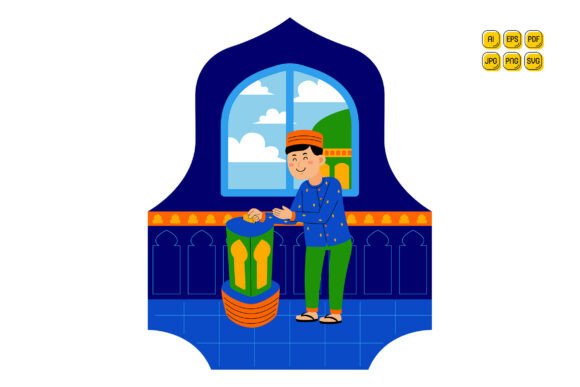
When I first opened the Man Donating to Charity Box at Mosque design file, my immediate reaction was one of quiet appreciation. As someone who has spent years reviewing embroidery designs for everything from boutique clothing lines to custom holiday gifts, I know that finding a graphic with genuine emotional resonance is rare. Most designs feel generic or overly cluttered, but this illustration carries a specific mood: one of generosity, community, and peace.
This isn't just another clipart image; it is a narrative moment captured in thread potential. The composition feels balanced, suggesting that the designer understood the importance of negative space and focal points. For an embroidery project, where every stitch counts and fabric texture plays a huge role, having a clear visual hierarchy is essential. This illustrations category piece stands out because it invites the viewer to pause, rather than shouting for attention. It is the kind of design that makes a customer stop scrolling on Etsy or pause at a craft fair booth to read the story behind the art.
From Digital File to Finished Product
The real test of any embroidery design happens when you move from the screen to the hoop. I recently considered using Man Donating to Charity Box at Mosque for a series of custom aprons intended for a local mosque community kitchen event. The goal was to create a keepsake that honored the spirit of giving without being too heavy-handed or overly detailed. When I mentally mapped out how the design would translate to fabric, several factors came into play.
First, consider the stitch density. A design like this needs enough fill to look substantial but not so much that it warps the fabric or becomes stiff. If the original vector includes dense areas for the donation box or the architectural details of the mosque entrance, those might require careful stabilization. In my experience, complex scenes often suffer on thin fabrics like standard cotton t-shirts unless a high-quality cutaway stabilizer is used. However, on sturdier materials like canvas tote bags or heavy-duty tea towels, this design could shine.
The versatility mentioned in the product description—specifically the ability to resize and change colors—is a massive advantage here. Imagine taking this same core concept and creating a set of matching items: a small embroidered patch for a volunteer's cap, a larger version on a sweatshirt for a fundraiser, and a simplified graphic for a digital flyer. The ability to adapt the graphics allows a small business owner to maintain brand consistency across different mediums while keeping the production costs manageable.
Real-World Application Scenarios
Let's talk about where this design truly fits in the handmade market. The theme of charity and community is evergreen, making it perfect for seasonal projects or year-round merchandise. I can easily envision this as a centerpiece for a holiday gift line. During Ramadan or Eid, families often look for meaningful gifts that reflect their values. An embroidered pillow cover featuring this scene could be a cherished addition to a living room, or perhaps a personalized baby blanket for a new family member joining the community.
For the craft business owner, the commercial potential is significant. If you are an Etsy seller, this design offers a unique angle. Instead of competing with thousands of generic floral patterns, you are offering a product with a story. Customers today value authenticity and connection. A tote bag embroidered with Man Donating to Charity Box at Mosque tells a story of faith and action. It elevates a simple accessory into a statement piece.
I also see great potential in corporate or organizational branding. Non-profits, mosques, and community centers often need uniforms or promotional items. This design works beautifully as a logo or accent on a polo shirt, a chef's jacket for a food bank, or even a decorative banner for a charity drive. The clean lines of the illustration ensure that it remains legible even when scaled down to a small chest pocket placement.
Technical Considerations and Potential Pitfalls
While the artistic merit is high, a professional review must address the technical realities of machine embroidery. Not every surface is suitable for every design. If you plan to use this on a curved surface like a baseball cap, you will need to pay close attention to the stitching direction. Curved surfaces can distort complex illustrations if the digitization isn't optimized for the curve. You might find that the finer details of the donation box get lost or distorted if the hoop size is too small relative to the design complexity.
Thread color contrast is another critical factor. On dark fabrics, light-colored threads can sometimes struggle to pop, especially if the design relies on subtle shading or fine running stitches. Before committing to a full run, I strongly advise testing the design on scrap fabric that matches your final product. Check the stitch density to ensure the threads aren't pulling too tightly, which could cause puckering. If the design includes satin stitch elements for outlines or text, verify that they won't bunch up on textured fabrics like fleece or thick denim.
There are also limitations regarding detail. If the original illustration contains tiny lettering or extremely intricate corner details, these may not hold up well after multiple washes. Embroidery is durable, but it is not indestructible. Small, delicate lines can fray over time, particularly on items that undergo frequent washing, such as work aprons or children's clothing. In these cases, simplifying the design or increasing the spacing between elements might be necessary to preserve longevity.
Practical Designer Notes for Success
To get the most out of Man Donating to Charity Box at Mosque, preparation is key. Always start by inspecting the file structure. Confirm whether the design is provided as a single layer or separated into distinct color blocks. This separation is crucial if you want to mix thread colors creatively or add applique elements to specific parts of the image, such as the donation box itself.
When setting up your machine, remember that proper stabilization is non-negotiable. For a design with this level of detail, a tear-away or cut-away stabilizer will provide the necessary support to prevent distortion. If you are working with stretchy fabrics like jersey or knits, a woven interfacing underneath is highly recommended to keep the design crisp.
Don't forget to test the visual impact in black and white mockups before finalizing your color choices. Sometimes, a design looks vibrant in color but loses its definition when converted to grayscale. This step ensures that the silhouette of the man and the box remains recognizable regardless of the thread palette you choose. Additionally, compare the design on both light and dark backgrounds to ensure the contrast is sufficient for your target audience.
Finally, always review the licensing terms carefully. If you intend to sell finished products featuring this design, you need to confirm that your license covers commercial use. Some digital embroidery files are restricted to personal use only, and violating these terms can lead to legal issues. Ensure you have the right permissions before listing your handmade product on platforms like Etsy or selling at craft fairs.
In conclusion, Man Donating to Charity Box at Mosque is a thoughtful, versatile asset for any designer looking to add depth and meaning to their work. It bridges the gap between aesthetic appeal and functional storytelling. Whether you are creating a custom gift for a loved one or building a line of branded merchandise for a small shop, this design offers a strong foundation. With careful planning, appropriate material selection, and a keen eye for detail, it can transform into a stunning finished product that resonates with customers on a deeper level.